

Most “best core exercises” lists hand you a stack of moves and leave you to figure out the rest. Which ones should you do first? How many days a week? Is your core actually weak, or does it just feel that way after a bad night’s sleep?
I’ve coached people through this for 20 years, and the pattern is always the same: everyone can name a plank or a crunch, but almost nobody has a plan. This guide fixes that. Below are 15 of the best core exercises for strength, stability, and balance—organized by what each exercise actually trains, not just how difficult it feels—plus a simple weekly structure and a 60-second self-test to help you know where to start.
Quick Answer: The best core exercises train your core to do its real job: resist movement, not just create it. A strong core workout combines anti-extension exercises (plank, dead bug), anti-rotation exercises (Pallof press, bird dog), and anti-lateral-flexion exercises (side plank). Aim for two to three sessions per week, 15–20 minutes each.
A 60-Second Test: Is Your Core Actually Weak?
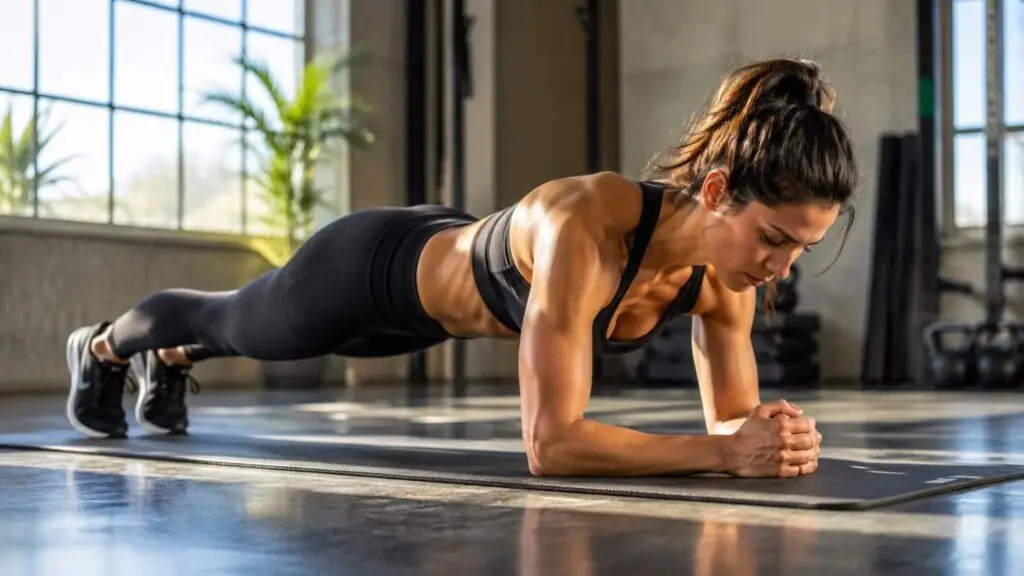
Before choosing core exercises for beginners or jumping straight into advanced movements, find out where you currently stand. Try a standard forearm plank and time how long you can maintain good form—keep your hips level, avoid sagging or arching your lower back, and maintain a straight line from your head to your heels.
| Plank hold time | What it suggests |
|---|---|
| Under 20 seconds | Start with beginner moves, twice a week |
| 20–60 seconds | You’re ready for the intermediate tier |
| Over 60 seconds with clean form | Add advanced, harder-to-stabilise variations |
This isn’t a competition. It’s simply a starting point—so the rest of this core workout guide can be tailored to your current fitness level.
Core Exercises for Beginners
Your core isn’t just your abs—it includes the rectus abdominis, obliques, transverse abdominis, erector spinae, multifidus, pelvic floor, and diaphragm as Harvard Health notes. These five exercises work together to train your core as an integrated system while providing a gentle starting point for beginners.
1. Glute Bridge
Lie on your back with your knees bent and feet hip-width apart. Engage your core and glutes, then lift your hips until your body forms a straight line from your shoulders to your knees. Hold for 10–30 seconds, then lower your hips with control. Repeat for 3–5 repetitions.
2. Dead Bug
Lie on your back with your arms reaching toward the ceiling and your knees bent at 90 degrees. Slowly lower one arm and the opposite leg without allowing your lower back to arch, then return to the starting position. This is one of the gentlest options for beginners and teaches core control without placing excessive stress on the spine.
3. Bird Dog
Start on all fours with your hands under your shoulders and knees under your hips. Extend one arm and the opposite leg until they are roughly level with your torso, keeping your back flat and your core engaged. Pause briefly, then return to the starting position and switch sides. This exercise trains coordination, balance, and core stability as much as strength.
4. Modified Plank (Knees Down)
Set up like a full plank, but rest on your knees instead of your toes. Keep your body in a straight line from your knees to your shoulders, brace your core, and hold the position for 10–20 seconds. This is a great starting point if a full plank causes your form to break down too quickly.
5. Supine Toe Tap
Lie on your back with your knees bent at 90 degrees. Slowly lower one foot to gently tap the floor, keeping your lower back in a neutral position, then return to the starting position. This movement is gentle on the spine and can be a good alternative if traditional crunches cause back discomfort.
Coach’s note: If you’ve been inactive for a while, start here regardless of age or fitness background. I’ve had strong, athletic clients humbled by the dead bug because it exposes compensation patterns that bigger lifts hide. Master control before you chase intensity.
Intermediate Best Ab Exercises
Once beginner moves feel controlled — not just possible, but controlled — these five add load, instability or rotation.
6. Standard Plank
Forearms and toes on the floor, straight line from head to heels, core and glutes braced. Hold 20–45 seconds for 3–4 rounds. Past a minute of clean form, progress to a harder variation rather than holding longer.
7. Side Plank
Forearm and the side of one foot on the floor, hips lifted into a straight line. Trains anti-lateral-flexion — resisting sideways collapse — which a front plank doesn’t touch. Hold 15–30 seconds per side.
8. Bicycle Crunch
On your back, hands behind your head, alternate bringing elbow to opposite knee while extending the other leg. Works obliques and rectus abdominis through rotation. 3 sets of 12 reps per side.
9. Bird Dog with Elbow-to-Knee
The bird dog above, but bring your extended elbow and knee together underneath your body before re-extending. Adds a controlled rotational element on top of the base stability challenge.
10. Pallof Press
Anchor a resistance band at chest height, stand side-on, press the band straight out without letting your torso rotate toward the anchor. This is the single best anti-rotation exercise there is — and it’s the one move missing from almost every “best core exercises” list, despite being a staple in physical therapy for exactly this reason.
Advanced Core Exercises
These five combine multiple core functions at once — stability, rotation resistance and load, often simultaneously.
11. Mountain Climbers
From a plank, drive one knee toward your chest, then alternate quickly while keeping hips level and back flat. Combines anti-extension with a real cardio component.
12. Side Plank with Rotation
From a side plank, thread your top arm underneath your body, rotating your torso, then return overhead. Strengthens obliques through a full rotational range rather than a static hold.
13. Ab Wheel Rollout
From your knees, roll the wheel forward as far as you can control without your lower back sagging, then pull back. One of the hardest anti-extension exercises available — start small and build the range over weeks.
14. Loaded Carry (Suitcase or Farmer’s Walk)
Carry a heavy dumbbell in one hand (suitcase) or both hands (farmer’s) and walk 20–30 metres without leaning. Trains your core to resist lateral flexion under real load — closer to how your core actually works outside the gym than almost any floor exercise.
15. Turkish Get-Up
A full-body sequence from lying to standing while holding a weight overhead. Genuinely advanced — practise the pattern without weight first. It builds spinal stability and shoulder control simultaneously, and it’s a favourite for clients who’ve plateaued on standard core work.
A Simple Weekly Core Workout Plan
The 30-second version Two to three core-focused sessions a week, 15–20 minutes each, choosing one move from each category — anti-extension, anti-rotation, anti-lateral-flexion — rather than doing five plank variations and calling it a day.
| Day | Focus | Example pairing |
|---|---|---|
| Monday | Anti-extension + anti-rotation | Plank + Pallof press |
| Wednesday | Anti-lateral-flexion + coordination | Side plank + bird dog |
| Friday | Integrated / loaded | Loaded carry + ab wheel rollout |
Two to three sets per move, resting 30–45 seconds between. Progress by adding time, reps or a harder variation — not by adding more exercises to an already long list.
Common Mistakes I See in the Gym
- Only doing anti-extension work. Planks and crunches are a fraction of what your core needs to handle. Rotation and side-loading get ignored constantly.
- Chasing plank time past a minute. Once your form is solid for 60 seconds, add resistance or complexity instead of just holding longer.
- Expecting visible change in two weeks. It typically takes four to six weeks of consistent training before you notice a real difference — physical therapists say the same thing, so don’t quit right before it shows.
- Skipping the self-test. Starting with advanced moves before your base is solid is the fastest way to build compensation patterns instead of real strength.
Core Exercise Myths vs. Facts
| Myth | Fact |
|---|---|
| Crunches are the best way to build a strong core | Crunches train one movement (flexion) out of three your core actually needs. Anti-rotation and anti-lateral-flexion work — largely ignored in most routines — matters just as much. |
| Doing core exercises daily gets faster results | Core muscles recover quickly, but 2–3 focused sessions a week outperform 7 rushed ones. More frequency isn’t the bottleneck for most people — exercise selection is. |
| A longer plank hold means a stronger core | Past about 60 seconds of clean form, plank time stops reflecting core strength and starts reflecting muscular endurance in one narrow pattern. Add load or complexity instead. |
| You can spot-reduce belly fat with core exercises | Not physiologically possible. Core work builds the muscle underneath; visible definition depends on overall body fat, which is a function of total calorie balance. |
| If your abs don’t hurt the next day, the workout didn’t work | Soreness reflects unfamiliar stress, not effectiveness. A well-programmed core session can produce real strength gains with minimal soreness once your body adapts. |
Summary
The best core exercises aren’t a random list — they train three distinct jobs: resisting extension (plank, dead bug), resisting rotation (Pallof press, bird dog) and resisting side-bending (side plank, loaded carries). Test where you stand, pick one move from each category, train two to three times a week, and give it a full month before judging results.
Frequently Asked Questions
A. Glute bridges, dead bugs, bird dogs and a modified knees-down plank are the safest starting points. They teach core bracing and control without loading the spine the way full planks or weighted moves do. Master these before progressing.
A. Two to three times a week is enough for most people. Core muscles recover faster than large muscle groups, but more isn’t automatically better — consistent, well-structured sessions beat daily, unfocused ones.
A. No. Spot reduction isn’t physiologically possible — Mayo Clinic confirms that core exercises build the muscle underneath, but visible fat loss depends on your overall calorie balance, not which muscle you’re training. Strong abs and visible abs are two different projects.
A. There isn’t a single “best” one — your core has to resist extension, rotation and side-bending, and no single exercise trains all three. The Pallof press, plank and side plank together cover more ground than any one move alone.
A. Most people notice a real difference in strength and stability after four to six weeks of consistent training, according to physical therapists who coach this regularly. Visible changes in appearance take longer and depend heavily on overall body fat.
A. You can, since core muscles recover relatively quickly, but it’s not necessary for most goals. Two to three focused sessions a week, done properly, will outperform seven rushed ones.
The Bottom Line
Skip the plank-time competitions. A core that resists rotation and side-loading under real conditions — carrying groceries, twisting to grab something, catching your balance — is worth more than any single number on a stopwatch. Pick one move from each category above and start there.
A few related pieces that expand on what I’ve touched on here:



Pingback: Is Functional Strength Training Actually Better Or Just Trendy? - RoutineRX Health & Wellness Routine Academy