
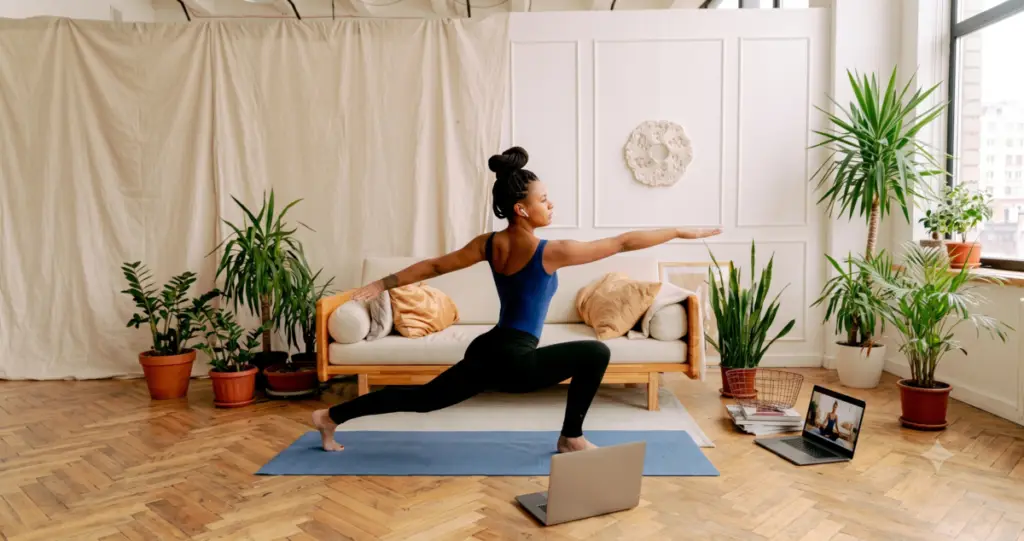

Last week, a client showed up to our session and, instead of her usual warm-up, was standing in the parking lot doing tree pose. “I saw this walking yoga thing on my feed,” she said, half-laughing, half-serious. “Is this actually real, or is it just yoga with extra steps?”
Fair question. It’s also the same question a lot of people are typing into Google right now — search interest in walking yoga has climbed sharply since 2024, and it’s showing up in 2026’s biggest walking trends alongside things like Japanese interval walking. So I tried it myself for a week before I answered her, and before I wrote a word of this.
Here’s what walking yoga actually is, what happened when I tested it, what the research does and doesn’t support, and a full beginner routine you can try today — no mat, no class, no yoga experience required.
What Is Walking Yoga?
Quick answer: Walking yoga combines standing yoga poses, synchronized breathing, and mindful awareness with the physical act of walking. You pause periodically during a walk to hold poses like Tree Pose or Warrior I, then keep walking — no mat or studio required.
It’s not a new invention wearing a new hashtag. Walking meditation and mindful movement have roots going back decades, and yoga teachers have used walking as a bridge between poses for just as long. What’s changed is the packaging: accessible, no-equipment, no-studio — which is exactly why it’s resonating with people who’ve felt intimidated by a traditional yoga class.
The mechanics are simple. Instead of unrolling a mat, you’re pausing at intervals to hold standing postures, syncing your breath with your steps, and staying present for the whole walk instead of scrolling through it on autopilot.
Walking Yoga vs. Walking Meditation vs. Mindful Walking
This is the question I get asked more than any other, and most articles on this topic use the three terms interchangeably. They shouldn’t.
| Practice | What it involves | Physical poses? | Best for |
|---|---|---|---|
| Walking meditation | Pure mindful awareness of each step and breath | No | People who want stillness of mind without adding movement complexity |
| Mindful walking | Sustained attention to sensation, surroundings, and breath during a normal walk | No | A lighter, more flexible entry point — works with any walk, any pace |
| Walking yoga | Standing yoga poses, breathwork, and mindful awareness woven into a walk | Yes | People who want the physical benefits of yoga without a studio or floor work |
Both walking meditation and mindful walking are forms of mindful movement. Walking yoga is the version that adds an explicit physical practice on top — which is also why it tends to deliver more in the way of balance and flexibility, and less in the way of pure mental stillness.
Why Is Everyone Suddenly Doing This?
I’ll be honest — when a fitness trend explodes this fast, my first instinct as a coach is skepticism. You’ll see the claim repeated across a lot of wellness sites that search interest has grown by exactly 2,414% since 2024. I couldn’t independently verify that specific figure back to a primary source, and I noticed it repeated, word for word, across several unrelated articles — which usually means everyone’s citing the same secondhand number rather than pulling their own data.
What I can verify is the direction: walking-based workouts are genuinely having a moment in 2026, and walking yoga is a consistent part of that conversation across multiple independent fitness trend reports. So take the exact percentage with a grain of salt. Take the underlying shift seriously.
Part of what’s actually driving it is straightforward burnout. After years of HIIT, CrossFit, and “no days off” messaging, a lot of people are looking for movement that supports their nervous system instead of taxing it further. Walking yoga sits right in that gap — moderate intensity, mentally restorative, low barrier to entry.
The Real Benefits — What Science Actually Supports
Trend pieces tend to overstate benefits. Here’s what’s genuinely reasonable to expect, based on what we know about walking, yoga, and mindfulness — individually and combined.
| Benefit | Why it happens |
|---|---|
| Improved balance | Standing poses challenge stability in a way regular walking doesn’t |
| Better flexibility | Poses like Warrior I and Standing Crescent stretch major muscle groups |
| Stress reduction | Breath-synced movement supports nervous system regulation |
| Cardiovascular benefit | The walking component provides genuine aerobic activity |
| More consistent movement habit | The lower barrier to entry means people actually stick with it |
The stress and mood evidence
A study published in Health Promotion Perspectives found that even a single brief bout of walking combined with mindfulness produced measurable mood improvements. Separately, a 2024 study in the International Journal of Environmental Research and Public Health found that a single guided mindful walk reduced state anxiety in university students.
That tracks with what I noticed during my own test week — the sessions where I actually paid attention to my breathing left me noticeably calmer than my usual “walk while checking my phone” routine. Not a controlled experiment, but it lines up with what the research would predict.
The balance and mobility evidence
A 2024 randomized controlled trial in BMC Geriatrics found mindful walking to be both feasible and safe for older adults — a meaningful finding, since all the standing poses in walking yoga avoid the floor work that makes traditional yoga harder to access for people managing joint pain or limited mobility.
Coach note: Walking yoga won’t replace a dedicated strength or cardio program if you’re training for a performance goal. Where it genuinely shines is as a recovery-day activity, a stress-management tool, or an entry point for people who find a traditional yoga class intimidating.
Can Walking Yoga Help You Lose Weight?
Short answer: it can support a calorie deficit, but it isn’t a weight-loss method on its own.
The walking component gives you genuine cardiovascular activity, and the World Health Organization recommends adults get 150–300 minutes of moderate-intensity aerobic activity per week — a walking yoga habit contributes toward that target the same way any brisk walk would. But holding a standing pose for 30–45 seconds burns very little on its own, and the CDC is clear that meaningful weight management depends on total activity volume and nutrition, not any single low-intensity practice.
If your goal is walking and yoga to lose weight specifically, treat walking yoga as the habit-builder that keeps you moving consistently, not the mechanism that burns the calories. Pair it with strength training two or three times a week and consistent nutrition, and it becomes a genuinely useful piece of a bigger plan — not a shortcut around one.
My 20-Minute Beginner Routine
Here’s exactly what I did on day one, and what I’d recommend to any client trying this for the first time.
- 5-minute warm-up walk — easy pace, focus on breathing in through your nose, out through your mouth
- Walk-and-flow intervals (10 minutes) — walk briskly for 2 minutes, then stop and hold a standing pose for 30-45 seconds. Repeat this cycle
- Cooldown (5 minutes) — slow walking pace with deep breathing, finishing with a final standing stretch
Standing Poses to Use During Your Walk
1. Tree Pose
Stand on one leg, place the sole of your other foot against your calf or inner thigh, hands at heart center. Builds balance and focus.
2. Warrior I
Step one foot forward into a lunge, back foot angled slightly out, arms reaching overhead. Opens the hips and stretches the legs.
3. Standing Crescent Stretch
Reach both arms overhead, clasp your hands, and lean gently to one side, then the other. Stretches the entire side body.
Every one of these is a beginner-accessible standing posture. No floor work, no advanced flexibility required — which is a large part of why this practice works for people who’ve never set foot in a yoga class.
Common Mistakes I See Beginners Make
| Mistake | Why it matters |
|---|---|
| Rushing through poses | You lose the mindfulness benefit that makes this different from a regular walk |
| Choosing uneven terrain for balance poses | Increases fall risk unnecessarily — pick flat, stable ground |
| Holding your breath during poses | Breathing is the core mechanism connecting the “yoga” part to the practice |
| Skipping the warm-up | Cold muscles make balance poses harder and less safe |
Who Should Check With a Doctor First
Walking yoga is low-impact and generally safe for most healthy adults. That said, if you have a balance disorder, a recent lower-body injury, or a condition that affects stability, check with a doctor or physical therapist before adding standing balance poses to your routine. The Mayo Clinic notes that most people can benefit from yoga in some form, but “most people” isn’t “everyone” — if you’re managing a chronic condition, loop in your care team before you start.
Myths vs. Facts
| Myth | Fact |
|---|---|
| Walking yoga is just marketing, not real exercise | The walking component provides genuine cardiovascular activity; the poses add balance and flexibility work regular walking doesn’t |
| You need yoga experience to try it | Every pose used is a beginner-accessible standing posture — no floor work or advanced flexibility required |
| It replaces strength training | It doesn’t build significant muscle mass; pair it with resistance training for a complete routine |
Expert Tips From a Coach
- Start with one pose, not three. Master Tree Pose on stable ground before adding Warrior I. Trying the full routine on day one is the fastest way to feel discouraged.
- Pick a route you already know. Save the balance work for familiar, flat terrain — new trails and new poses don’t mix well in week one.
- Attach it to a walk you already take. The habit sticks better as an add-on to an existing routine than as a brand-new commitment.
- Don’t skip the boring part. The warm-up walk feels unnecessary. It isn’t — cold hip flexors and a cold nervous system make balance poses genuinely harder.
Frequently Asked Questions
A. Walking yoga combines standing yoga poses, synchronized breathing, and mindful awareness with the physical act of walking. Practitioners pause periodically during a walk to hold poses such as Tree Pose or Warrior I, then continue walking. No mat or studio is required.
A. Walking meditation focuses purely on mindful awareness of each step and breath, with no physical poses involved. Walking yoga adds structured standing yoga postures and breathwork at intervals during the walk. Both are forms of mindful movement, but walking yoga includes an explicit physical practice component.
A. Early evidence suggests it can. A single brief bout of walking combined with mindfulness produced measurable mood improvements in a study published in Health Promotion Perspectives, and a 2024 study in the International Journal of Environmental Research and Public Health found a single guided mindful walk reduced state anxiety in university students.
A. Generally yes. A 2024 randomized controlled trial published in BMC Geriatricsfound mindful walking to be feasible and safe for older adults, and it may be especially useful for balance and flexibility since all poses are performed standing, without getting up and down from the floor. People with existing balance or mobility concerns should consult a doctor first.
A. A typical beginner session runs about 20 minutes: a 5-minute warm-up walk, 10 minutes of alternating brisk walking with 30–45 second standing poses, and a 5-minute cooldown. Sessions as short as 10 minutes can still produce measurable mood benefits.
A. It can support a calorie deficit through its walking component, but it is not a high-calorie-burn activity on its own. It works best paired with strength training and consistent nutrition habits rather than as a standalone weight-loss method.
A. No. Every pose used in walking yoga is a beginner-accessible standing posture — no floor work or advanced flexibility is required, which is a large part of why the practice appeals to people intimidated by traditional yoga classes.
A. Common poses include Tree Pose (standing balance on one leg), Warrior I (a standing lunge with arms reaching overhead), and Standing Crescent Stretch (a side-body stretch with hands clasped overhead). All are performed standing, without a mat.
Key Takeaways
- Walking yoga blends standing poses and breathwork with regular walking — no mat needed.
- It’s genuinely distinct from walking meditation and mindful walking, which skip the physical postures.
- Real, evidence-supported benefits include improved balance, flexibility, and stress reduction.
- It can support weight loss as part of a broader routine, but it isn’t a standalone method.
- A simple 20-minute routine — warm-up, walk-and-pose intervals, cooldown — is enough to start.
- It complements, but doesn’t replace, dedicated strength training.
The Button Line
After a week of testing this myself, my honest take: walking yoga isn’t a gimmick, but it’s also not a replacement for a complete fitness routine. Where it earns its place is as a genuinely enjoyable recovery-day practice something that gets you outside, moving, and actually present, instead of scrolling through a walk on autopilot.
If you’ve been putting off trying yoga because a studio class feels intimidating, this is about as low-barrier an entry point as fitness gets. Give the 20-minute routine above a try this week and see how it feels.