
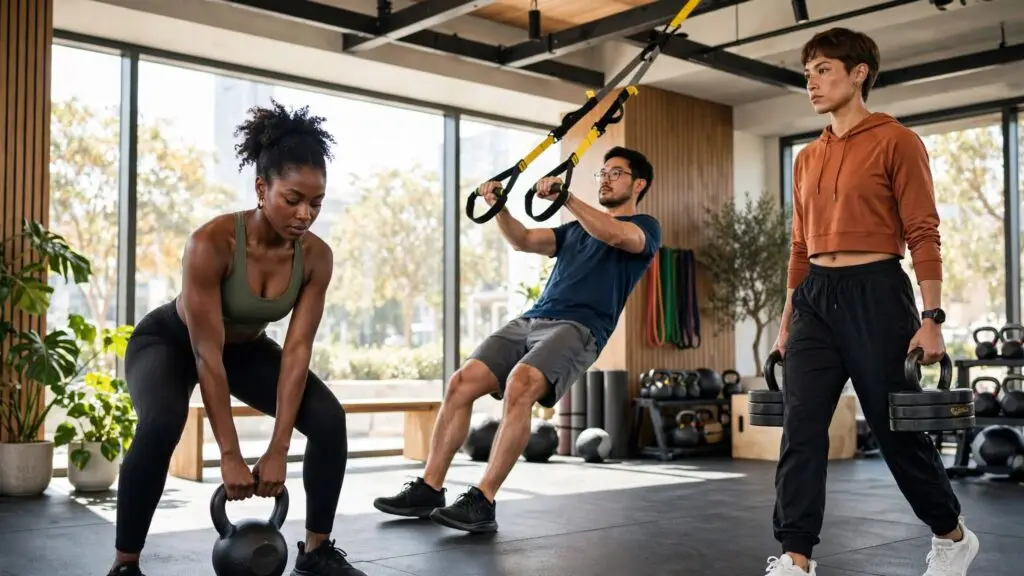

A client once asked me, mid-set, why I had her carrying two heavy dumbbells across the gym floor instead of sitting in a machine. Fair question. It looked less like “working out” and more like she was moving furniture.
That’s kind of the point. Functional strength training isn’t built around how an exercise looks in a mirror — it’s built around whether the strength you’re gaining actually shows up in your life. If you’re exploring a broader strength training routine and keep hearing trainers push this term, here’s the honest answer: is it substance, or just the fitness industry’s latest costume change?
This guide breaks down what functional strength training actually is, what the evidence realistically supports, and how to build a beginner-friendly routine — without pretending it’s the only way to get strong.
What Is Functional Strength Training?
Quick answer: Functional strength training focuses on exercises that mimic real-world movement patterns — squatting, hinging, pushing, pulling, and carrying — rather than isolating single muscles. The goal is building strength that transfers directly to daily activities and sports performance, not just muscle size or a single-lift number.
How It Differs From Traditional Strength Training
Traditional strength training often isolates one muscle at a time — think a bicep curl or a leg extension machine. Functional training leans toward compound, multi-joint movements that ask several muscle groups to work together, the way your body actually moves through a day.
Neither approach is “wrong.” A bodybuilder chasing muscle size has different goals than someone training to get up off the floor easily at 70. Functional training is a philosophy about what to prioritize, not a replacement for strength training as a whole.
The Core Movement Patterns (Squat, Hinge, Push, Pull, Carry)
Most functional programs organize around five foundational patterns:
- Squat — sitting down and standing up (a chair, a car seat, the floor)
- Hinge — bending at the hips to lift something (a deadlift pattern; picking up a bag)
- Push — pressing something away from you (a push-up; pushing a door open)
- Pull — bringing something toward you (a row; pulling a suitcase off a shelf)
- Carry — holding weight while walking (groceries, a toddler, luggage)
Tip: If you can’t name which of these five patterns an exercise trains, it’s a useful question to ask before adding it to a “functional” routine — the label gets used loosely in marketing.
Why Trainers Are Recommending It in 2026
Quick answer: Trainers often recommend functional strength training because it builds strength, balance, and coordination that carry over into everyday tasks and may reduce injury risk by training movement patterns rather than isolated muscles. It’s frequently used alongside, not instead of, traditional strength training as part of a well-rounded program.
The Shift Toward Real-World Movement
Part of what I’ve watched change in coaching over the past several years is client priorities. Fewer people walk in only wanting bigger arms — more want to keep up with their kids, travel without their back giving out, or simply move through life without wincing. Functional training answers that specific ask more directly than a strict isolation program does.
What Certifying Bodies Say About It
Major strength and conditioning certifying organizations — including the National Academy of Sports Medicine (NASM), the American Council on Exercise (ACE), and the National Strength and Conditioning Association (NSCA) — have incorporated functional and movement-pattern-based training into their certification curricula and continuing education for years now, reflecting a broader professional consensus that training real-world movement patterns has genuine value alongside traditional strength work. (These link to each organization’s homepage, not a specific article — swap in a precise, current source page before publishing once you can verify one directly.)
The Benefits of Functional Strength Training
Everyday Strength and Injury Prevention
Training compound movement patterns builds coordination between muscle groups, not just size in any one of them — which is a meaningful part of what makes everyday tasks (carrying, bending, catching your balance) feel easier and may lower injury risk from awkward, unpracticed movements.
Balance, Coordination, and Core Stability
Many functional exercises are performed standing, often unilaterally (one arm or leg at a time), which challenges your core and balance systems in a way that seated, fully-supported machine exercises typically don’t.
Benefits for Athletes vs. General Fitness Goals
Athletes often use functional-style training to build strength that transfers to their sport’s actual movements — a rotational carry for a golfer, a loaded lunge for a runner. General fitness clients benefit from the same transfer logic, just pointed at daily life instead of a sport.
Functional Strength Training vs. Traditional Strength Training
When to Choose One Over the Other (Comparison Table)
| Functional Strength Training | Traditional Strength Training | |
|---|---|---|
| Primary goal | Real-world movement transfer | Muscle size, isolated strength |
| Movement style | Compound, multi-joint | Often single-joint/isolated |
| Best for | Daily function, general athleticism, injury resilience | Targeted hypertrophy, rehabilitating a specific muscle |
| Typical equipment | Kettlebells, dumbbells, bodyweight, bands | Machines, cables, barbells |
| Common downside | Can be harder to isolate a lagging muscle group | Can neglect balance/coordination if used exclusively |
Note: These aren’t competing teams. Most well-designed programs — mine included — blend both, using functional patterns as the backbone and adding isolation work where a specific goal calls for it.
Functional Strength Training Exercises to Know
Beginner Exercises (Minimal or No Equipment)
- Bodyweight squat
- Glute bridge (hinge pattern)
- Push-up (or incline push-up)
- Standing row with a resistance band
- Suitcase carry with any household weight
Intermediate Exercises (Kettlebells, Dumbbells, Bands)
- Kettlebell swing
- Goblet squat
- Single-arm dumbbell row
- Farmer’s carry with dumbbells
- Dumbbell reverse lunge to overhead press
How to Build a Functional Strength Training Routine
A Sample Beginner Weekly Plan
3 non-consecutive days a week, one exercise per movement pattern per session:
- Day 1: Bodyweight squat, glute bridge, push-up, band row, suitcase carry
- Day 2: Rest or light walking
- Day 3: Goblet squat, kettlebell hip hinge (or deadlift pattern), incline push-up, single-arm row, farmer’s carry
- Day 4: Rest
- Day 5: Repeat Day 1 pattern, adding a small amount of load or reps
Sets, Reps, and Progression Basics
Start with 2–3 sets of 8–12 reps per exercise, resting 60–90 seconds between sets, in line with general resistance-training guidance from bodies like the American College of Sports Medicine (ACSM). Once that feels manageable with solid form, add small amounts of weight or reps — not both at once — before increasing complexity or combining movements.
Checklist — before your first functional training session:
- Comfortable with basic bodyweight squat and hinge form
- Have at least one light weight (dumbbell, kettlebell, or filled bag) available
- Cleared a few feet of open floor space
- Know which pattern each exercise in your session trains
Who Functional Strength Training Is Especially Good For
Older Adults
Movement patterns like the squat, hinge, and carry map directly onto tasks that tend to get harder with age — standing from a chair, picking things up, carrying groceries. If you’re an older adult starting this kind of training, or managing an existing condition, checking in with your doctor or a physical therapist before adding load is a reasonable, worthwhile step, not an overcautious one.
Athletes
Rotational carries, single-leg work, and loaded movement patterns can support the specific demands of a given sport, though a good functional program for an athlete is usually built by a coach who understands that sport’s actual movement demands.
Desk-Job Workers and Everyday Movers
If most of your day is spent sitting, functional patterns — especially hinges and carries — directly counteract the postural and strength gaps a sedentary routine tends to create.
Common Mistakes to Avoid
- Treating “functional” as a magic label. An exercise isn’t automatically better because it’s marketed as functional — check that it actually trains a real movement pattern with good form.
- Skipping the basics for complexity. Balance-board push-ups look impressive; a shaky, unloaded squat pattern underneath them is a problem you’re building on top of, not around.
- Ignoring isolation work when you actually need it. If you’re rehabbing a specific weak muscle, some isolated work still has a place.
- Adding load before form is solid. Compound movements have more that can go wrong under load than a machine does — patience here pays off.
Warning: Stop and reassess if you feel sharp joint pain (different from normal muscle fatigue) during any functional exercise. If it persists, check in with a physical therapist or doctor before continuing that movement.
Is Functional Strength Training a Fad, or Here to Stay?
Here’s my honest take, and where I’ll push back on the “just trendy” framing a bit: the branding around functional training comes and goes, but the underlying idea — that strength should transfer to how you actually move through life — isn’t new, and isn’t likely to disappear. Coaches have prioritized movement patterns over isolated muscles for decades under different names.
What’s genuinely worth being skeptical of is any specific product, class format, or influencer program that slaps “functional” on the label without training real movement patterns well. The concept has substance. Not every application of it does.
Key Takeaway:
- Functional strength training centers on five movement patterns: squat, hinge, push, pull, and carry.
- It’s a complement to traditional strength training, not a replacement — most solid programs use both.
- Beginners can start with bodyweight versions of each pattern before adding equipment or load.
- The “trend” label applies more to marketing around functional training than to the underlying training principle itself.
Frequently Asked Questions
A. Yes, functional strength training can be beginner-friendly since many exercises use bodyweight or light equipment and build foundational movement patterns. Beginners should still start with proper form guidance, ideally from a certified trainer, and progress gradually rather than adding load or complexity too quickly.
A. Common functional strength exercises include squats, deadlifts, lunges, push-ups, rows, loaded carries, and kettlebell swings — movements that use multiple joints and muscle groups together, similar to real-world actions like lifting, carrying, or standing up from a chair.
A. Yes. Many functional exercises need minimal or no equipment — bodyweight squats, push-ups, glute bridges, and carries using household items (a filled backpack, a laundry basket) all train real movement patterns without a gym.
A. Neither is strictly “better” — they serve different goals. Functional training prioritizes movement transfer to daily life and sport, while traditional strength training is often better suited to targeted muscle growth or isolated rehab. Most well-rounded programs use elements of both.
A. Functional strength training focuses on exercises that mimic real-world movement patterns — squatting, hinging, pushing, pulling, and carrying — rather than isolating single muscles. The goal is building strength that transfers directly to daily activities and sports performance, not just muscle size or a single-lift number.
A. Trainers often recommend functional strength training because it builds strength, balance, and coordination that carry over into everyday tasks and may reduce injury risk by training movement patterns rather than isolated muscles. It’s frequently used alongside, not instead of, traditional strength training as part of a well-rounded program.
A. Traditional strength training often isolates individual muscles (like a bicep curl), while functional strength training emphasizes multi-joint, compound movements that mirror real-life actions, such as squatting to pick something up or carrying groceries. Both approaches build strength; functional training prioritizes practical, everyday movement transfer.
A. Not necessarily. Bodyweight versions of the squat, hinge, push, pull, and carry patterns are enough to start with. Equipment like kettlebells, dumbbells, and resistance bands lets you progress the same patterns further once bodyweight versions feel manageable.
A. Three non-consecutive days a week is a solid, sustainable starting point for beginners, allowing recovery time between sessions. As your fitness improves, frequency and complexity can increase, ideally guided by how well your body is recovering, not just a fixed schedule.
The Bottom Line
Functional strength training isn’t a gimmick — it’s a genuinely useful lens for organizing your training around how your body actually needs to move, not just how a muscle looks in the mirror. Whether it’s “trendy” or not, the underlying principle holds up.
If you’re ready to put these patterns into a broader plan, our guide on building a strength training program from scratch is a natural next step once these five movements feel comfortable.
A few related pieces that expand on what I’ve touched on here:

