
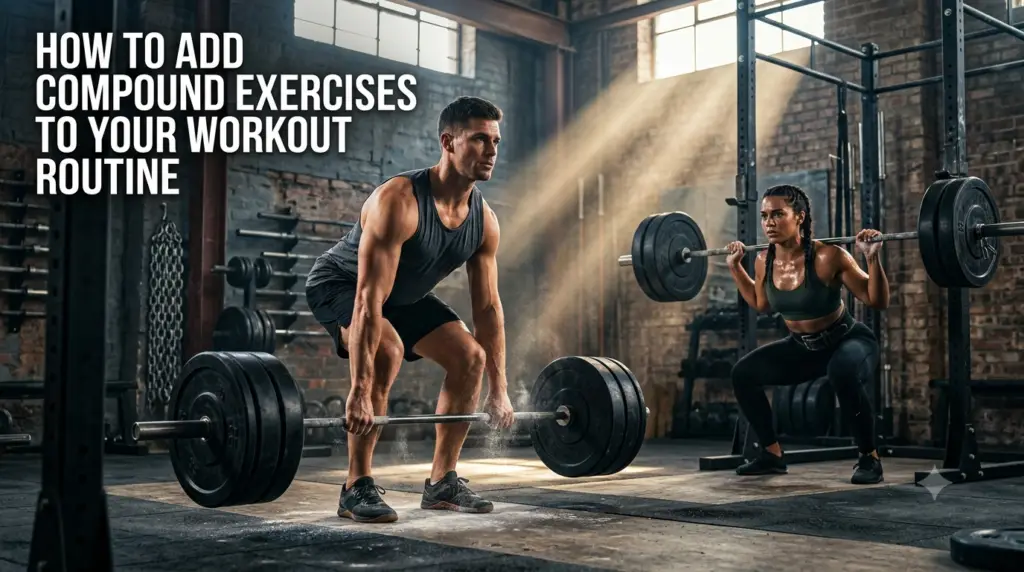

Have you ever wondered why experienced lifters and personal trainers often prioritise compound exercises over isolated movements? The answer lies in efficiency. Instead of working a single muscle, compound exercises engage multiple muscle groups and joints simultaneously, helping you build strength, burn more calories, and improve overall fitness in less time.
Whether you’re aiming to lose weight, gain muscle, or simply move better in daily life, compound exercises deserve a place in your workout routine. As a fitness coach, I’ve found that many beginners initially focus on exercises like bicep curls or leg extensions. While those movements have value, real progress often comes from mastering foundational compound movements that challenge your entire body.
Scientific research also supports this approach. Organisation such as the American College of Sports Medicine (ACSM) recommend multi-joint resistance exercises because they improve muscular strength, coordination, and functional fitness more effectively than relying solely on single-joint movements.
If your goal is to maximise calorie burn, you may also enjoy our guide on 10 Exercises That Burn the Most Calories for Weight Loss.
What Are Compound Exercises?
Compound exercises are movements that involve two or more joints and multiple major muscle groups working together during a single exercise.
Unlike isolation exercises, which target one specific muscle, compound movements recruit several muscles at the same time. This allows you to lift heavier loads, improve coordination, and complete more effective workouts in less time.
For example:
- A squat works your quadriceps, hamstrings, glutes, calves, and core.
- A deadlift activates your back, glutes, hamstrings, core, and grip muscles.
- A push-up strengthens your chest, shoulders, triceps, and abdominal muscles.
Because these exercises mimic real-life movements such as lifting, pushing, pulling, and climbing stairs, they help improve functional strength that carries over into everyday activities.
Why Compound Exercises Matter
Modern lifestyles often involve long hours of sitting, which can weaken muscles and reduce mobility. Compound exercises help reverse these effects by training the body to move as one coordinated unit rather than as separate muscle groups.
Some of the biggest advantages include:
- Improving posture and balance.
- Enhancing athletic performance.
- Building total-body strength.
- Increasing daily calorie expenditure.
- Saving time by training multiple muscles in one movement.
Whether you work out at home or in a gym, compound exercises provide excellent value for your training time.
💡 Health Tip
Beginners should focus on learning proper technique before increasing weight. Good movement patterns reduce injury risk and create a stronger foundation for future progress.
Compound Exercises vs. Isolation Exercises
Many people wonder whether compound or isolation exercises are “better.” The truth is that both have a place in a well-rounded fitness program, but they serve different purposes.
| Feature | Compound Exercises | Isolation Exercises |
|---|---|---|
| Joints Used | Multiple | One |
| Muscle Groups | Multiple | Single |
| Calories Burned | Higher | Lower |
| Strength Development | Excellent | Moderate |
| Functional Fitness | High | Limited |
| Time Efficiency | Excellent | Lower |
| Best For | Overall fitness, muscle growth, weight management | Muscle definition, rehabilitation, correcting imbalances |
For most people, especially beginners, compound exercises should form the foundation of a workout routine, with isolation exercises added as needed for specific goals.
Benefits of Compound Exercises
1. Burn More Calories
One of the biggest reasons compound exercises are popular is their ability to increase calorie expenditure.
Because multiple muscles work together, your body requires more energy to perform each repetition. This can help support a calorie deficit when combined with healthy eating, making compound exercises a valuable tool for weight management.
Exercises such as squats, deadlifts, and lunges typically burn more calories than single-joint movements because they recruit larger muscle groups and elevate your heart rate.
2. Build Muscle More Efficiently
Compound exercises stimulate several muscle groups at once, allowing you to train more efficiently.
For example, a barbell deadlift strengthens your:
- Glutes
- Hamstrings
- Lower back
- Core
- Forearms
- Upper back
Instead of spending time on multiple isolation exercises, you can train these muscles together in a single movement.
This efficiency is especially helpful if you have limited time to exercise.
💡 Health Tip
Prioritize quality over quantity. Performing fewer compound exercises with proper form often delivers better results than doing many exercises with poor technique.
3. Improve Functional Fitness
Functional fitness refers to your body’s ability to perform everyday activities safely and efficiently.
Compound movements closely resemble daily actions such as:
- Lifting groceries.
- Climbing stairs.
- Picking up children.
- Carrying heavy bags.
- Standing from a seated position.
By strengthening the muscles used in these movements, compound exercises make everyday life easier while reducing injury risk.
4. Increase Overall Strength
Since compound exercises allow heavier loads than most isolation exercises, they are excellent for developing full-body strength.
Training multiple muscle groups simultaneously also improves:
- Coordination
- Stability
- Grip strength
- Joint health
- Athletic performance
This makes compound movements ideal for beginners and experienced lifters alike.
5. Support Weight Management
If your goal is long-term weight management, compound exercises can play a major role.
Resistance training helps preserve lean muscle while dieting, and maintaining muscle mass supports a healthy metabolism. Compound exercises also encourage greater overall energy expenditure during workouts.
When combined with balanced nutrition and regular physical activity, they provide a sustainable approach to improving body composition.
💡 Health Tip
Pair compound strength training with at least 150 minutes of moderate aerobic exercise per week, as recommended by health authorities, for optimal health and weight management.
6 Best Compound Exercises to Try
After understanding what compound exercises are and why they are so effective, it’s time to put them into action. These six exercises are among the most effective movements for improving strength, increasing calorie burn, enhancing balance, and supporting long-term weight management.
Whether you’re a beginner or an experienced lifter, mastering these movements will help you get more out of every workout.
💡 Health Tip
Always begin your workout with a 5–10 minute warm-up, such as brisk walking, light cycling, or dynamic stretches. Warming up increases blood flow, improves mobility, and reduces the risk of injury.
1. Deadlift
The deadlift is one of the most effective full-body compound exercises because it strengthens your entire posterior chain while improving grip strength, posture, and core stability.
Equipment Needed: A barbell (optional). Add weight plates to increase the challenge as your strength improves.
Muscles Targeted: Forearms, latissimus dorsi (lats), glutes, hamstrings, core, and the upper, middle, and lower back.
How to Perform a Barbell Deadlift
Repeat for 10–12 repetitions, then rest for 30–60 seconds before the next set. Aim to complete 3 sets.
- Stand with your feet hip-width apart and position the barbell over the middle of your feet, with your toes underneath the bar.
- Push your hips back while bending your knees slightly. Keep your core engaged and maintain a neutral spine with your back flat throughout the movement.
- Grip the barbell with both hands slightly wider than shoulder-width, allowing your arms to hang straight.
- Keeping your chest up and knees slightly bent, press through your heels as you lift the bar.
- Raise the bar by extending your hips and knees at the same time, keeping the barbell close to your body throughout the lift.
- Stand tall at the top of the movement and squeeze your glutes for a full lockout.
- Slowly lower the barbell back to the floor by hinging at your hips while maintaining a flat back.
2. Reverse Lunge to Balance with Bicep Curl
This functional movement combines lower-body strength, upper-body training, and balance in a single exercise.
Equipment Needed: A pair of dumbbells.
Muscles Targeted: Glutes, hamstrings, abdominals (core), hip muscles, and biceps.
How to Perform a Dumbbell Reverse Lunge with Bicep Curl
- Stand with your feet hip-width apart, holding a dumbbell in each hand. Let your arms hang naturally by your sides with your palms facing your body.
- Step your right foot backward and lower your body into a reverse lunge until both knees are bent at approximately 90 degrees.
- Push through your left heel to return to the starting position, balancing on your left leg. Keep your right foot off the floor as you come up.
- While maintaining your balance, perform a bicep curl by bending both elbows and lifting the dumbbells toward your shoulders.
- Slowly lower the dumbbells back to your sides while stepping your right leg back into the reverse lunge.
- Complete 6–8 repetitions on your right leg before switching to your left leg.
- Rest for 60–90 seconds after both sides are complete, then repeat for 2–3 sets.
💡 Health Tip
Balance exercises improve joint stability and may reduce the risk of falls and sports-related injuries.
3. Squat
Few compound exercises are as effective as the squat. Whether you’re lifting a barbell or using only your body weight, squats strengthen the largest muscles in your body.
Equipment Needed: No equipment required.
Muscles Targeted: Quadriceps, glutes, and calves.
How to Perform a Bodyweight Squat
- Stand with your feet slightly wider than hip-width apart and turn your toes slightly outward.
- Keep your chest lifted, engage your core, and shift your weight into your heels as you push your hips back.
- Lower your body by bending your knees and hips until your thighs are parallel, or nearly parallel, to the floor. Keep your knees aligned with your toes throughout the movement.
- Press through your heels to return to the starting position while keeping your chest up and core engaged.
- Squeeze your glutes at the top of the movement before beginning the next repetition.
- Perform 10–15 repetitions and gradually build up to 3 sets.
4. Front Lunge with Twist
This dynamic exercise combines strength training with rotational movement, making it excellent for athletes and anyone wanting stronger core muscles.
Equipment Needed: No equipment required.
Muscles Targeted: Glutes, hamstrings, core (abdominals), and hip muscles.
How to Perform a Forward Lunge with Torso Twist
- Stand tall with your feet shoulder-width apart and extend your arms straight in front of you at shoulder height.
- Step your right foot forward into a lunge, lowering your body until both knees are bent at approximately 90 degrees. Keep your front knee directly above your ankle without allowing it to extend past your toes.
- While holding the lunge position, rotate your upper body to the right, then slowly return to the center.
- Push through your right heel to return to the starting position.
- Repeat the movement by stepping forward with your left leg and twisting to the left.
- Complete 8–10 repetitions on each leg and gradually build up to 3 sets.
💡 Health Tip: Controlled rotational exercises help strengthen the core muscles that protect your spine during everyday movements.
5. Dumbbell Shoulder Press on an Exercise Ball
Using a stability ball increases core activation while strengthening the shoulders
Equipment Needed: A pair of dumbbells and an exercise (stability) ball.
Muscles Targeted: Core (abdominals), deltoids (shoulders), pectoralis major (chest), and triceps.
How to Perform a Seated Dumbbell Shoulder Press
- Perform 12–15 repetitions and gradually build up to 3 sets. a stability ball for shoulder and core strength.
- Sit on an exercise ball with your feet firmly planted on the floor and engage your core to maintain balance.
- Hold a dumbbell in each hand, resting them on your thighs.
- Use your thighs to help lift the dumbbells to shoulder height. Your elbows should be bent at a 90-degree angle, with your palms facing forward.
- Press the dumbbells straight overhead until your arms are fully extended without locking your elbows.
- Slowly lower the dumbbells back to shoulder height, keeping your elbows at a 90-degree angle. Avoid lowering the weights below shoulder level, as this can place unnecessary stress on your shoulder joints.
6. High Plank T-Spine Rotation
This movement improves thoracic spine mobility while strengthening your core and upper body.
Equipment Needed: No equipment required.
Muscles Targeted: Core (abdominals) and shoulders.
How to Perform a Plank with Arm Rotation
- Begin in a high plank position with your hands directly under your shoulders and your feet about hip-width apart.
- Engage your core, tighten your glutes and thighs, and keep your body in a straight line from head to heels.
- Press your right hand firmly into the floor as you lift your left arm toward the ceiling, rotating your shoulders and hips to the left.
- Pause briefly at the top while maintaining control, then slowly return your left hand to the floor.
- Repeat the movement on the opposite side by pressing your left hand into the floor and raising your right arm toward the ceiling.
- Continue alternating sides for 8–10 repetitions per side.
- Rest if needed, then complete up to 3 sets.
💡 Health Tip
Thoracic mobility exercises can improve posture, reduce upper-back stiffness, and enhance overhead movement patterns.
Compound Exercises Workout Schedule
One of the biggest advantages of compound exercises is that you don’t need to spend hours in the gym. A structured weekly routine allows your muscles to recover while promoting steady strength gains.
Goal: Learn proper form and build a solid fitness foundation.
| Day | Workout |
|---|---|
| Monday | Full Body Compound Workout |
| Tuesday | Brisk Walking or Light Cycling (30 minutes) |
| Wednesday | Full Body Compound Workout |
| Thursday | Mobility & Stretching |
| Friday | Full Body Compound Workout |
| Saturday | Yoga or Active Recovery |
| Sunday | Rest |
Exercises
- Bodyweight Squats – 3 × 12
- Dumbbell Deadlifts – 3 × 10
- Reverse Lunges – 3 × 10 each leg
- Dumbbell Shoulder Press – 3 × 10
- High Plank T-Spine Rotation – 3 × 8 each side
💡 Health Tip
Aim for 48 hours of recovery before training the same major muscle groups again. Rest is when muscles repair, adapt, and grow stronger.
Common Mistakes to Avoid During Compound Exercises
Even experienced gym-goers occasionally make errors that reduce effectiveness or increase injury risk.
Avoid these common mistakes:
- ❌ Lifting Too Heavy Too Soon
- ❌ Skipping Warm-Up
- ❌ Poor Posture
- ❌ Holding Your Breath
- ❌ Ignoring Recovery
💡 Health Tip
Adults should aim for 7–9 hours of quality sleep each night to support muscle recovery, hormone balance, and exercise performance.
Safety Tips for Compound Exercises
Compound movements involve multiple joints, so safety should always come first.
Before Your Workout
- ✔ Warm up for 5–10 minutes
- ✔ Wear supportive footwear
- ✔ Choose appropriate weights
- ✔ Stay hydrated
During Exercise
- ✔ Maintain proper form
- ✔ Control every repetition
- ✔ Engage your core
- ✔ Avoid jerky movements
- ✔ Use a spotter for heavy lifts
After Exercise
- ✔ Cool down
- ✔ Stretch major muscles
- ✔ Eat a protein-rich meal
- ✔ Drink plenty of water
If you experience sharp pain, dizziness, or unusual discomfort, stop exercising and seek medical advice if symptoms persist.
Who Should Avoid Certain Compound Exercises?
Although compound exercises are safe for most healthy adults, some individuals should consult a healthcare professional or qualified trainer before starting.
Examples include:
- Recent surgery
- Severe arthritis
- Chronic back pain
- Pregnancy (exercise modifications may be needed)
- Heart conditions
- Uncontrolled high blood pressure
Frequently Asked Questions (FAQs)
Q. What are compound exercises?
Q. Are compound exercises better than isolation exercises?
Q. Can beginners do compound exercises?
Q. Do compound exercises burn more calories?
Q. Which compound exercise burns the most calories?
Q. How often should I perform compound exercises?
Q. How many compound exercises should I do per workout?
The Takeaway
Compound exercises are one of the most efficient ways to build strength, improve fitness, burn calories, and support healthy weight management. By training multiple muscle groups at once, they save time while delivering impressive results for beginners and experienced exercisers alike.
Whether your goal is fat loss, muscle gain, or simply moving better in everyday life, exercises such as deadlifts, squats, lunges, shoulder presses, and plank variations provide a strong foundation for long-term success.
Focus on mastering proper technique, progress gradually, and pair your workouts with balanced nutrition, sufficient recovery, and consistency. Small improvements made regularly often lead to the most meaningful results over time.